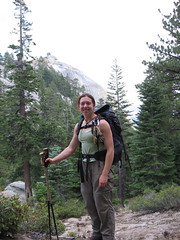
Clare Hiking to Magic Dragon
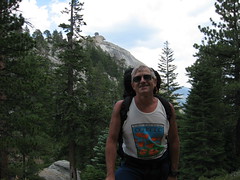
Walter excited to climb
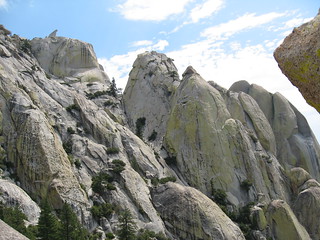
Wizard Formation from Magic Dragon
I worked my day off last Friday in order to climb on Monday. I wanted to have a little Eastern Sierra adventure. The plan was to drive up to the Needles on Sunday night, in order to get an early start Monday morning.
Most Needles climbs start off with a refreshing hike. In the case of Magic Dragon, the hike is 2.5 miles and then an extra 30 minutes of light bushwacking from the main trail!
Sunday, I picked up the Runkle-Man at approx. 5:15pm. We cruised past Johnsondale, where the air was filled with haze and smoke. Some Eastern Sierra ridges were on fire! Even though it was miles off in the distance, the smoke was permeating. We got to the campsite near the trailhead of the Fire Lookout Tower at just about 7:30pm. The temps outside were PERFECT.
Upon arrival, I immediately got my gear ready for the morning. We were both really stoked about the climb. It had been 3 years since Walter’s last ascent with Ridgecrest local Al Green. Walter’s super sweet lightweight 60m rope + my new rack = endless potential.
The Magic Dragon climb is 10 pitches. Half of it is slab climbing, and the other half is a surprisingly fun granite problem solving adventure. There is some loose rock still on the climb, so wear a helmet if ya can. Beware of ants in the trees, and the bees. Take plenty of water! The bottom half of the route is in the shade until probably 12pm, the top is in the sun probably all day long. It is hot hot hot in direct sun in the summer.
Luckily, we had overcast skies all day, with a slight, cool breeze. How lucky we are…except I was not feeling well all day. I believe it was a combination of the altitude (8000ft+) and not sleeping well (what happens when I’m TOO well hydrated). Anyways, I carried on with the climb, but was feeling shaky and weak all day. I’m happy Walter stayed on the sharp end for me, as I’m sure the day would have ended in disaster otherwise.
Magic Dragon is a great route, I would highly recommend this climb if you are in the Needles area. We left the trailhead at a few minutes before 6am. By 8am, we were climbing. We topped out at around 1pm. And that was with me moving slow!
So, plan for a half day and start EARLY as the summer sierra storms typically build up in the mid to late afternoon. As in our case, by the time we started our hike back at 2:30pm the dark clouds were building up. We were back at the truck by 3:15pm.
As if to congratulate us for our send, we heard a roar of thunder, and then droplets of freezing cold water graced us!!! It felt great, since we were done with the route and hot from the exertion of hiking.
We then spent a few minutes unwinding, raiding the icechest, and changing out of nasty smelly climbing clothes. Walter had a Sapporo, and I gulped down a starbucks frappuccino, ice cold. We were off to Kernville for dinner.
Go to Ewing’s on the Kern in Kernville, for a fancy dinner, if you’re in the area. The view of the Kern river is just awesome! Food comes out hot, and is delish. Large portion sizes so beware. Also, at night they feed Raccoons, so you can see them crawling outside the windows of the porch. Their slogan is “A view with a room”. Deservedly so, it really is romantic!!! Walter and I were both thinking, “Gee, our spouses would love this place!”.
Anyways, after dinner, we drove back to Ridgecrest where it was a balmy 115+ F outside! We were both so happy we spent Monday up in the mountains on a climb instead of at work. Totally worth the 26 bucks of gas to get up there!!! In two weeks, we’ll all be up at our annual Tuolumne Meadows climbing/hiking/biking extravaganza. I can’t wait to get out of the heat again!
****For those of my climbing friends who want pitch by pitch descriptions of Magic Dragon, continue reading! For the non climbers, beware the following might be extremely dull reading! More Route Beta and pictures below!****
On Sunday night, we had a lengthy discussion about which cams to take (we knew we needed some big stuff)! And, we decided to take all my Black Diamond cams up to the #4. We added his older model BD #4.5 cam, as we would need it for the start pitch of the route.

Walter at the Start

Me excited for that crack above!
If I did the route in the future, I would prefer to have a newer model #5 cam instead of the #4.5, and a second #3 to protect that first pitch safely. As it was, the first pitch was runout in spots with at least one semi creepy 20+ft gearless gap! Walter had done it before WITHOUT the #4.5. I think that’s crazy unless you’ve done it a million times, or have the moves memorized.
Another suggestion, other than bringing bigger cams, is to haul sneakers with you up the climb. The walk back to the stashed packs is so much more enjoyable in sneakers. A HUGE plus for this climb, if you can manage.

Crack stuffed with gear. A #5 BD Cam would really be helpful here!
The first pitch is a fairly sustained 5.7 chimney, lieback, and stemming type climb. Very gratifying, good feedback on granite rock. Ample protection possibilities if you have what it takes. Some flared cracks, so cam placements can be awkward, be careful or the cams will get a case of the squiggly wigglies.

End of First Pitch and Belay Spot for second pitch.
We ran the first pitch well past where the traditional first belay is, opting to go past two trees ending up at a large shrubby tree at the base of a finger crack. Be careful as there are lots of blocky rocks the size of coconuts at the top of the ledge, so they can be shaken loose by the follower as they come over the ledge. Or the rope can knock them loose, if the leader is sloppy with the belay and anchor placement.
The second pitch of climbing was quite thrilling. A wonderful little finger crack with some great toe-jams and stemming. Another beauty of a pitch. Great for those smaller sized gear, we used my metolius cams, but I think a few nuts would go in no prob. It was not as long as the first pitch, since we really stretched it out.

Walter at the end of Pitch 2.

Looking back down Pitch 2.
We went until we got to a small ledge at the base of a left facing block. The ledge was about 4 inches wide, but there was a great vertical seam on the right where we plugged in some decent sized cams for the belay. It’s nice to have the belayer that high, as they can easily scope out the crux moves of the leader…which are about 15 feet above and to the left around a corner from the belay.
The third pitch crux is a doosie, as you can see in the picture below. It is listed in Walter’s guidebook as 5.5, and we are not too finicky about ratings, but we both agree that HAS to be a typo. It is EVERY bit of 5.8, and could be 5.9 if you were unfamiliar with the pitch or didn’t know which direction the route goes.

Crux of Pitch 3
Essentially, we had a #4 cam just off the anchor (to protect for factor 2 falls), and then the next piece was a blue cam (#3) up high below and to the right of the lip of a pretty impressive 5 foot tall protruding headwall. Once the headwall is obtained, by virtue of a stategically located crimper, one can place a small cam (Red Metolius) into a rectangular shaped pocket over the edge of the lip of the wall.
The move getting OVER the wall is quite tricky. It took Walter awhile to figure it out, and once he committed to the move, it was NO PROBLEMO. It took a good deal of concentration for him to stay focused at that crux move, I was stoked he was able to make the move. Incidently, I did not free the pitch on TR, I had to aid myself over to the #3 cam for it’s removal, as he had shoved it way beyond my reach! I made the move in a couple of minutes, since I really had it down after watching warrior Walter.
After the crux headwall, the angle of the climb eases off a bit, but then you are in a crack, which is great for shoving a foot or knee into. There are little plants growing out of the crack, so be careful not to get that plant matter onto your rubber, as it will make the shoes slick. When the crack runs out, it hits a ledge. *Before* you traverse over on the ledge, make sure to protect the follower by placing a directional.
Traverse that ledge about 15-20 feet to the left, and continue up another crack (mini arete type thing) with large handholds and a few gear opportunities. When you hit the obvious saddle, it is the end of the third pitch.

View from end of Pitch 3

Psyched to be Climbing in the Needles. Nice belay stance and ready for Pitch 4.
The belay up there offers spectacular views of many classic Needles climbs. We could see where we had been, on White Punks, two weeks ago! NEATO. To me, this is where the best part of this climb ends. 4 of the last 6 pitches are slab.

You can see White Punks on Dope in this picture.

Walter ready for Pitch 4
After the saddle, the fourth pitch goes up slab until you are in a crack (we set up a semi hanging belay in the crack). But most folks do it at a large ledge before the crack. No biggie. We ran it out a full pitch, and we *almost* made it past the crack to a ledge with a tree on it. Unfortunately, we needed about 10 more feet of rope, so we just made do with the less than desirable belay halfway up the crack.
From the hanging crack, the fifth pitch goes up and around to the left, climbing on top of a deep, narrow gap in the granite. There is a continuous line of granite on the right side of the gap which can be straddled like a cowboy riding a horse. But, I opted to place my feet on it and lieback the left side of the gap. Awkward, but I didn’t feel like riding a stone horse when the rock was so hot!
There is a crack at the next anchor (shoulder sized ledge), so Walter had placed a few pieces of pro for the anchor. I remember a #1 or #2 and possibly a red Metolius, with a #12 (purple colored) stopper very solidly placed. Fifth belay felt comfy after that hanging belay (see below).

Close up from 5th pitch, looking back down


Another view of White Punks on Dope
From that belay, the sixth pitch is almost a FULL pitch to the next anchors. No pro, just slab. The anchors were rusted and one of them was wiggly. Questionable. At least they provided a third bolt with hanger for the leader to place a quickdraw on in the event of a leader fall. Although, it looked like a friggin Leaper hanger! Ackkk. Good thing Walter is a slabmaster, and it is easy to just walk up the pitch.
The seventh pitch is almost identical in nature to the sixth. The difference being that on it’s belay, BOTH anchors are rusty and loose. Geesh.
The eigth pitch involves more slab that eases off onto a horizontal ledge (like several cars could park up there). Traverse to the left around a corner to some blocky ledges. Walter set a belay at a vertical seam and gave me a hip belay over there.
From that spot, there is one more “pitch” to get you to the alternative rappel down, or-stopping short-at the base of the blocky ledges in order to reach the Tower. Typically, the tenth pitch goes up these blocky ledges, pulling through a final cruxy 5.8 hand crack move to top out right by the Fire Outlook Tower.

Looking back at Pitch 8.

An alternative belay

No cookies for climbing on Mondays…ahhhh, darn!
We did not do the tenth pitch as we were climbing on a Monday and the Tower is closed. So we ran the nineth pitch all the way over to the alternate belay station and headed downward.

Victors of Magic Dragon

Ropegun Walter on top of Magic Dragon
Locating the 2nd set of rap stations wasn’t too hard, but it was tricky angling over to the dirt ledge for the hike out. If you go straight down, you’ll end up near a pine tree and end up having to scramble that much further UPHILL to get back on the trail.
Nice writeup Clare, thanks! Those runout slab pitches sound nervewracking.
The slab was not bad. If it was wet, though, that would be a whole nuther story! The slab pitch on WPOD was much more serious stuff! Thank goodness for Walter’s perserverence and mental stamina.